Where Drift Fits
This page explains where Drift fits within a modern API testing strategy. It clarifies Drift’s purpose, how it differs from functional and end‑to‑end (E2E) testing tools, and how it complements the wider testing ecosystem.
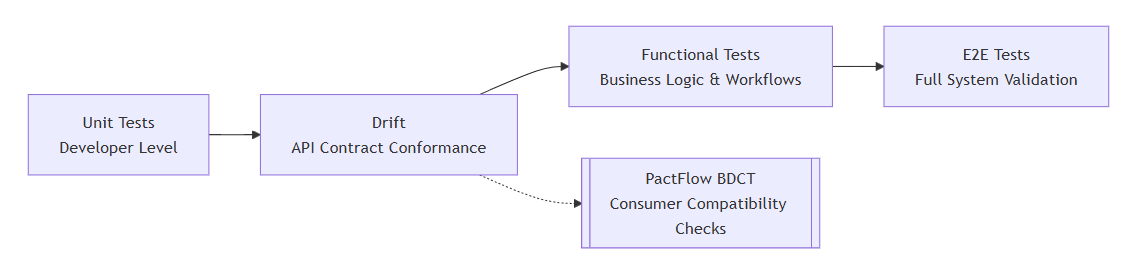
This diagram shows how Drift fits into the broader API testing workflow, sitting between unit tests and functional tests, with PactFlow providing ecosystem-level compatibility.
Many teams assume that because Drift can execute API calls, it should also validate multi-step workflows, business rules, or downstream system behavior. This is a common misconception. Drift’s role is narrower and more precise: to verify that an API implementation conforms to its published specification.
What Drift is Designed to Test
Drift performs contract conformance testing - fast, deterministic checks that validate whether an API implementation matches its published specification.
Drift validates:
request/response structure
status codes
headers and media types
JSON schema conformance
examples from the OpenAPI document
path, query, and header parameter constraints
narrow, controlled statefulness (e.g., verifying
200vs 404 for known IDs)
Drift supports limited, operation‑scoped stateful testing where the state is local, controlled, and does not depend on earlier test execution. See: Testing APIs With State Dependencies.
These checks are fast, isolated, and highly repeatable - ideal for local development, CI pipelines, and production validation.
Message-Based APIs
Drift applies the same contract conformance model to message-based APIs described by AsyncAPI. Instead of sending a request and validating a response, Drift publishes or captures messages over a real broker and validates them against the message schemas in your AsyncAPI document.
For message-based APIs, Drift validates:
message payload structure and schema conformance
message headers and metadata
correlation between a request and its reply
that a service publishes the event its contract declares
that a service handles a command it declares it consumes
The scope boundary is the same. Drift verifies one declared interaction at a time. It does not verify multi-step choreography, message ordering, delivery guarantees, or throughput. Those belong to functional and end-to-end testing, exactly as they do for HTTP.
What Drift is Not Designed to Test
Drift does not validate broader system behavior, including:
multi-step workflows requiring prior operations
scenario sequencing (“set system state then test”)
business rules or domain logic
system‑wide side effects (DB updates, events, queues)
cross-service or distributed behaviors
These concerns belong to functional, integration, or E2E testing.
Where Drift Fits in the Testing Pyramid
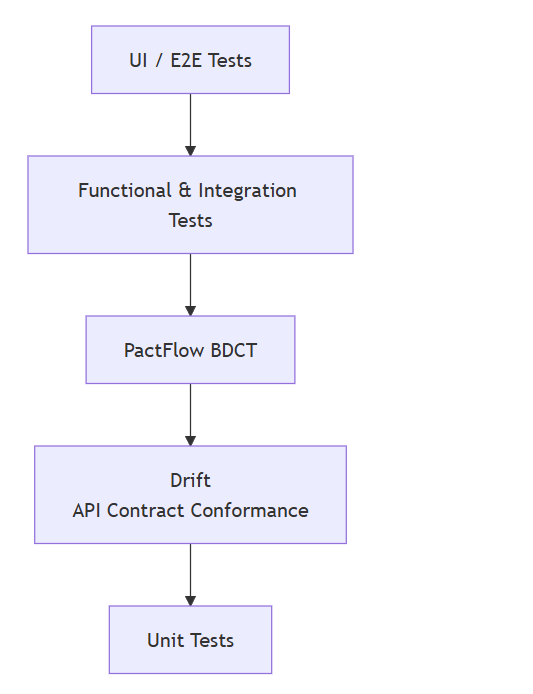
Drift sits in the lower/middle layers, providing:
rapid structural validation
high coverage of API behaviors
reduced reliance on expensive E2E workflows
By verifying each API operation independently, Drift reduces duplication in higher‑level testing.
Using Drift Alongside Functional and E2E Tests
Drift verifies
request/response correctness
adherence to OpenAPI contracts
types, structures, formats, and constraints
handling of invalid inputs
Functional tests verify
business rules and domain logic
multi-step workflows
behavioral correctness of system components
E2E tests verify
user-facing flows across the full system
integration of multiple services and infrastructure components
With Drift ensuring contract correctness early, functional and E2E tests can focus exclusively on validating meaningful system behavior.
Drift + PactFlow: System-Level Safety Without E2E Overhead
Drift provides strong implementation-level guarantees. Combined with PactFlow BDCT, teams gain:
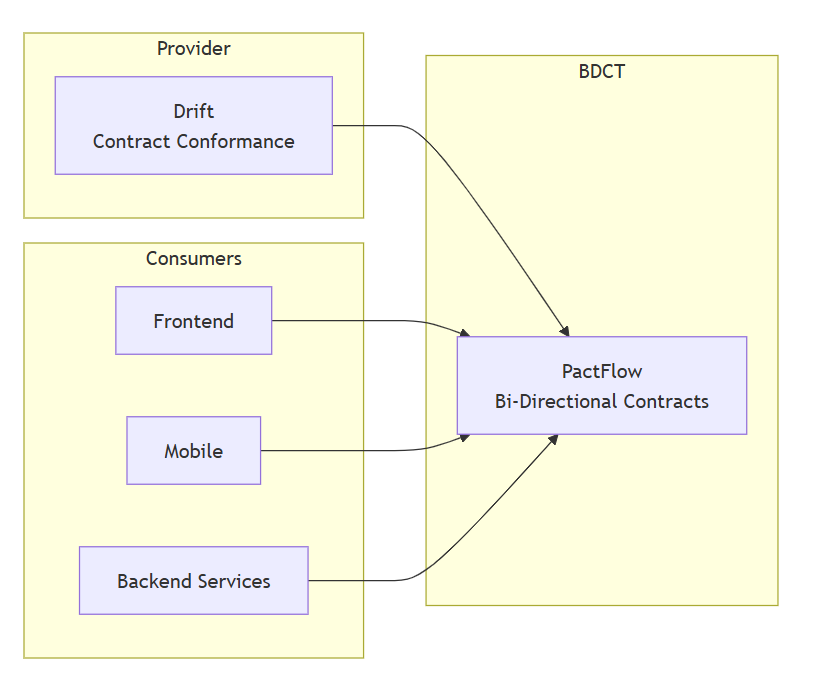
Together, Drift validates your API implementation and PactFlow BDCT verifies consumer compatibility, providing high confidence with minimal operational overhead.
visibility into how consumers actually use the API
automated compatibility checks
cross-team safety without shared test environments
reduced reliance on slow, brittle E2E tests
Best Practices
Validate every API operation using Drift
Use functional tests for business rules, not schema validation
Keep E2E tests minimal and focused on high‑value scenarios
Integrate Drift early in CI/CD
Use PactFlow BDCT for cross‑system compatibility insight
Drift vs Functional Tests vs E2E Tests
Definitions
Contract Conformance - Ensuring an API implementation matches its published specification.
Functional Testing - Testing business rules, workflows, and behavioral logic.
End-to-End (E2E) Testing - Testing the full system across all integrated components.
Narrow Statefulness - State local to a single API operation.
The table below summarises which concerns Drift handles, and which require functional or E2E testing.
Capability / Concern | Drift | Functional Tests | End-to-End Tests |
|---|---|---|---|
Validate API contract conformance | Yes | Indirect | Indirect |
Validate request/response structure | Yes | Sometimes | Sometimes |
Validate schema & data types | Yes | Indirect | Indirect |
Validate headers & media types | Yes | Partial | Partial |
Validate status codes | Yes | Sometimes | Sometimes |
Operation-level correctness | High confidence | Medium | Low |
Narrow statefulness | Supported | Supported | Supported but brittle |
Multi-step workflows | Not Supported | Supported | Fully Supported |
Scenario sequencing | Not encouraged | Supported | Fully Supported |
Business rules / domain logic | Not in scope | Full | Partial |
System-wide side effects | Not in scope | Partial | Full |
Cross-service behavior | Not in scope | Limited | Fully supported |
Typical execution speed | Fast | Medium | Slow |
Flakiness risk | Low | Medium | High |
Maintenance cost | Low | Medium | High |
Best suited for | API correctness | Business logic & workflows | End-to-end system validation |
Validate message schema conformance | Yes | Indirect | Indirect |
Validate message headers and metadata | Yes | Partial | Partial |
Validate request/reply correlation | Yes | Sometimes | Sometimes |
Multi-step message choreography | Not Supported | Supported | Fully Supported |
Message ordering guarantees | Not in scope | Partial | Full |
Delivery and retry semantics | Not in scope | Partial | Full |
Message-Based Contract Conformance - Ensuring the messages a service publishes and consumes match the AsyncAPI document that describes them.
Inline Examples
These simplified examples illustrate how Drift differs from functional and E2E testing tools.
Example 1: What Drift Tests
Scenario: POST /orders requires a valid customerId and returns an orderId.
Drift checks:
structure of the request
required fields
response body matches the schema
correct status code and headers
It does not check whether the order was created in the database.
Example 2: What Drift Does Not Test
Scenario: Creating an order should reserve inventory.
This requires:
calling /orders
verifying inventory count changes
checking events/queues or other services
This is a multi-step business workflow, suitable for functional or E2E testing.
Example 3: Using Drift + Functional Tests Together
Drift Test:
Functional Test:
Combination outcome:
Drift ensures the API’s structure and contract are correct
Functional tests ensure the system behaves correctly
This is a multi-step business workflow, suitable for functional or E2E testing.
Summary
Drift is most effective when used for:
validating your API against its published specification
catching issues early and reliably
reducing reliance on heavy end-to-end tests
fitting cleanly into the lower/middle layers of the testing pyramid
Used alongside functional tests and PactFlow BDCT, Drift provides a fast, modern, highly effective approach to API quality and release safety.
Examples
See these real-world projects to see how Drift fits into a full system:
example-bi-directional-provider-drift - A focused example showing Drift used as the provider verification tool in a BDCT workflow with PactFlow.
OpenTelemetry Demo - A multi-service demo combining OpenTelemetry instrumentation with Pact contract testing, showing how Drift fits into a larger distributed system.